Can you get ISO 9001 certified without a consultant?
Yes — a small business can reach ISO 9001 certification without a consultant, and it is often the smarter choice. The standard only asks you to describe how you already work, keep a few records, and review them yearly. Here is the exact five-stage path you can walk yourself — and the one step where a 179 € shortcut replaces 3,000 €+ of consultant time.
- €179 one-time — no subscription
- Delivered within 48 hours
- 15–20 page A4 PDF
- Built to ISO 9001:2015
How a small business reaches ISO 9001 — without paying for a consultant.
Straight answer: yes — a small business can get ISO 9001 certified without a consultant, and it is often the smarter choice. The standard only asks you to describe how you already work, keep a few records, and review them once a year. Here is the exact five-stage path you can walk yourself — and the single step where a €179 shortcut replaces 3.000 €+ of consultant time.
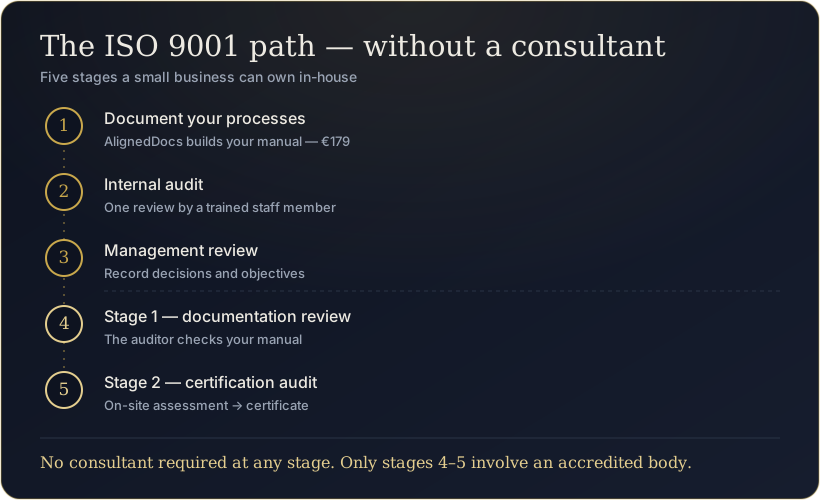
The five-stage path, step by step
- Document your processes. Your quality manual is the foundation — AlignedDocs builds it from your business for €179.
- Run one internal audit. A trained staff member checks the system against the standard.
- Hold a management review. Record your decisions, objectives and improvements.
- Stage 1 audit. An accredited certification body reviews your documentation.
- Stage 2 audit. An on-site assessment — then your certificate is issued.
Doing it yourself vs hiring a consultant
| Do it yourself | Hire a consultant | |
|---|---|---|
| Total cost to certification | 2.000–6.000 € all-in | 8.000–20.000 €+ |
| Documentation | €179 (AlignedDocs) | 3.000–8.000 € |
| Timeline | Weeks, at your pace | Weeks to months |
| Control of your system | Stays in-house | External dependency |
| The certificate itself | Identical | Identical |
Step 1: Understand the standard, then map your reality
Start by getting familiar with what ISO 9001:2015 actually asks for. It is far less bureaucratic than its reputation suggests — the documentation requirements are minimal, and for a small business they may be little more than writing down what you already do. The standard is a flexible framework, not a rigid rulebook; it is meant to be adapted to how your business genuinely operates.
Then run a gap analysis: go through the requirements and honestly mark where you already comply and where you do not. For a small, well-run business, you will usually find you are doing most of it already — you just have not written it down. That gap, between what you do and what is documented, is the real work of ISO 9001.
Step 2: Build the documentation (where consultants overcharge)
This is the stage consultants bill the most for, and the stage you can most easily take back. The mandatory documents are a manageable set: your quality policy, the scope of your system, measurable quality objectives, and the documented procedures and records the standard requires. The principle for a small business is lean documentation — add detail only where your processes genuinely need it, not to impress an auditor.
A warning from real-world data: a large share of purely self-written systems need major revisions before they pass, usually because the documentation either copies a generic template that does not match the business, or over-documents to the point of collapse. The fix is not to hire a consultant — it is to build the documentation from your actual business answers. That is exactly what AlignedDocs produces: an individual, standard-compliant manual from your real processes, for €179 instead of consultant rates.
Step 3: Run it, then audit yourself
Documentation alone does not certify you — you have to actually operate the system for a period so there are records to show. Then ISO 9001 requires at least one internal audit before certification: a structured self-inspection where you observe your own processes, check records, and confirm the system works as written. A staff member can be trained to do this; it does not require an external consultant.
This internal audit is also your safety net. It catches the gaps before the real auditor does — the place where your documented process and your actual practice drift apart. Fix those internally, and you walk into the certification audit already knowing your system holds together.
Step 4: The certification audit (the only part you cannot self-do)
Finally, an accredited certification body audits you in two stages — Stage 1 reviews your documentation, Stage 2 assesses your live operation. This is the one step that genuinely requires an external party, because certification must be independent to mean anything. You choose the certification body and pay them directly; this is the unavoidable cost, separate from any documentation or consultancy.
Notice what just happened: of the four steps, three are entirely within your control, and only the final audit requires an outside party — and that party is the certification body, not a consultant. The consultant was never mandatory at any stage. The honest takeaway is that a capable small business can self-implement ISO 9001 and reserve its money for the one cost that actually buys the certificate.
Source: ISO — ISO 9001:2015 Quality management. Figures reflect typical 2026 UK/EU market rates for small businesses.
Skip the consultant. Start with the documentation that passes.
Three of the four steps are yours to own. We give you the hardest one — a print-ready quality manual built from your business — for €179.