What does ISO 9001 certification actually cost in 2026?
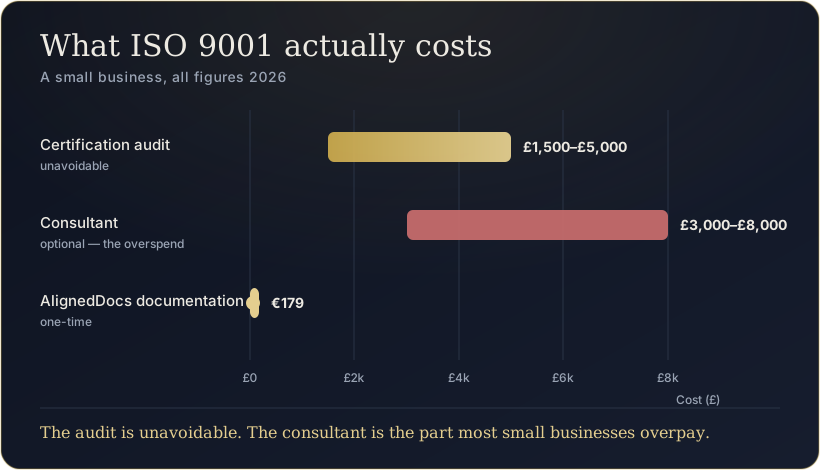
ISO 9001 certification for a small business typically costs 2,000–6,000 € all-in when you do it yourself — the certification audit (1,500–5,000 €) is unavoidable, but the biggest overspend is a consultant (3,000–8,000 €) most small firms do not need. Below is the honest 2026 breakdown, fee by fee, and exactly which parts you can keep in-house.
- €179 one-time — no subscription
- Delivered within 48 hours
- 15–20 page A4 PDF
- Built to ISO 9001:2015
Where the money actually goes — and where you can stop it leaking.
Straight answer: for a small business, ISO 9001 certification usually costs 2.000–6.000 € all-in if you do it yourself — essentially the certification audit (1.500–5.000 €) plus a few hundred for documentation. The single biggest avoidable cost is a consultant (3.000–8.000 €) most small firms do not need. Below is the full breakdown with 2026 figures, and exactly which parts you can keep in-house.
The full cost picture — at a glance
| Cost item | Typical 2026 cost | Can you avoid it? |
|---|---|---|
| Certification audit (Stage 1 + 2) | 1.500–5.000 € | No — paid to the registrar |
| Consultant (full service) | 3.000–8.000 € | Yes — most small firms skip it |
| Documentation (manual + procedures) | €179 with AlignedDocs | Yes — vs 3.000 €+ via consultant |
| Training | Low — online courses | Reduce — do it in-house |
| Internal audit | In-house staff | Reduce — no consultant needed |
| Surveillance audits (years 1–2) | ≈60–70% of audit fee | No — ongoing, but modest |
What is the unavoidable cost — the certification audit?
This is the one cost you cannot remove. An accredited certification body must audit your business in two stages — a Stage 1 documentation review and a Stage 2 on-site assessment. For a small business, the combined audit typically costs between 1.500 € and 5.000. € depending on your size, number of sites, and the certification body you choose. This fee is paid directly to the registrar, not to any consultant, and it is what earns you the actual certificate.
On top of the initial audit, ISO 9001 runs on a three-year cycle: you pay smaller annual surveillance audits in years one and two, then a recertification audit in year three. Budget roughly 60–70% of your initial audit fee for each surveillance visit. This is ongoing, but it is modest compared to the first-year total.
Where do most small businesses overpay? On consultants.
Here is where small businesses lose the most money. A full-service ISO 9001 consultant typically charges between 3.000 € and 8.000 € — and full implementation consultancy can run far higher, into five figures, for larger or more complex projects. Many businesses assume this is mandatory. It is not. A consultant is one option, not a requirement, and for a small business it is frequently the single largest and most avoidable line item.
The reason consultants are so often hired is simple: businesses do not know that the documentation — the part consultants charge most for — can be produced far more cheaply. The quality manual, the documented procedures, the policy and objectives: these are the deliverables, and they do not require a 5.000 € retainer to create. This is exactly the gap AlignedDocs fills — the documentation foundation for €179 instead of thousands.
What are the smaller costs — documentation, training, internal audit?
Beyond the audit and any consultant, there are three modest costs — and each one is something a consultant will gladly charge premium rates for, yet a capable small business can handle directly:
- Documentation — your quality manual and procedures. A template or a service like AlignedDocs replaces expensive consultant hours here.
- Training — making sure you and your team understand the standard and your roles, done through affordable online courses rather than in-person consultants.
- Internal audit — ISO 9001 requires at least one internal audit before certification, which a trained staff member can perform in-house.
None of these three needs to be expensive. The recurring theme is the same: each one is something a consultant will gladly charge premium rates for, and each one a capable small business can handle directly or with a low-cost tool. The skill is knowing which corners are safe to cut — and documentation is the safest of all.
What is a realistic total cost for a small business?
Add it up honestly. With a consultant doing everything, a small business commonly spends 8.000–20.000 € or more to reach certification. Doing it yourself with a documentation toolkit or service instead of a consultant typically brings the total down dramatically — often to little more than the unavoidable audit fee plus a few hundred euros for documentation and training. The certificate is identical either way; an auditor does not care whether a consultant or you produced the manual, only that it is correct.
That is the core insight: the certificate costs what the audit costs. Everything above that is a choice. The biggest lever you control is the documentation — and that is precisely the lever AlignedDocs hands you for €179.
Source: ISO — ISO 9001:2015 Quality management. Figures reflect typical 2026 UK/EU market rates for small businesses.
Get the documentation foundation for €179 — not €5,000.
The audit fee is unavoidable. The consultant is not. Start with a print-ready quality manual built from your business.