ISO 9001:2026 — what changes, and should you still certify now?
Yes — certifying to ISO 9001:2015 now is still worth it. The 2026 revision is an evolution, not a rebuild: the core requirements (Clauses 4–10) change only slightly, and you get a roughly three-year transition window after publication. A 2015 certificate stays valid until around 2029. Below is what actually changes — and why waiting costs you more than transitioning later will.
- €179 one-time — no subscription
- Delivered within 48 hours
- 15–20 page A4 PDF
- Built to ISO 9001:2015
An evolution, not a revolution — and a reason to start now, not wait.
Straight answer: ISO 9001:2026 is expected to publish around September 2026, with first 2026 certificates around 2027 and a transition period running to roughly 2029. The core framework stays the same — most additions are clarifications and guidance, not new mandatory requirements. So if you are weighing whether to certify to the 2015 version now, the answer is yes: you gain the benefits today and transition later with minimal effort.
ISO 9001:2026 — the key facts at a glance
| Question | Answer | What it means for you |
|---|---|---|
| When is it published? | Around September 2026 | Dates can still shift slightly |
| How big are the changes? | Minor in the core clauses (4–10) | Light transition if you meet 2015 |
| Is my 2015 certificate still valid? | Yes — through the transition (≈2029) | Certify now without worry |
| When are first 2026 certificates? | Around 2027 | No rush to be first |
| What's the main new emphasis? | Climate, leadership culture, clarity | Mostly clarifications, not new burdens |
| Should I wait to certify? | No — waiting costs you benefits | Start on 2015, transition later |
What actually changes in ISO 9001:2026?
The headline is reassuring: the revision evolves the standard rather than replacing it. The core clauses (4–10) see only minor changes, and most of the added length sits in non-mandatory front matter and Annex A guidance. The substantive points commonly cited are climate change formally integrated into the organization's context (Clause 4.1, building on the 2024 Amendment), expanded leadership responsibility around quality culture and ethical behaviour (Clause 5.1.1), and clearer wording on risk, management-review inputs and supplier monitoring to reduce audit inconsistency.
There is also a stronger nod to digital reality — data integrity and oversight where AI or automation touches quality processes — but for a typical small business this is guidance to consider, not a heavy new burden. If you already meet ISO 9001:2015, the gap to 2026 is small.
Should you still certify to ISO 9001:2015 now?
Yes — and waiting is usually the more expensive choice. A 2015 certificate earned now stays valid through the transition period (to roughly 2029), and because the core requirements barely move, your transition later is a light update rather than a fresh start. Many businesses make the mistake of pausing in the run-up to a revision and lose a year of the operational and commercial benefits a working QMS delivers.
Put plainly: the standard you build to today is the same standard, structurally, that you will maintain after 2026. Starting now means you carry a working system into the transition — not a blank page.
How do you prepare without over-engineering it?
For a small business, sensible preparation is light and practical — not a reason to delay:
- Keep your context current — make sure climate change is considered in your context and risk register where relevant (already required since the 2024 Amendment).
- Show quality culture — top management demonstrating a quality culture is exactly what the 2026 leadership clause expands.
- Document with clear structure — a well-organised manual makes any future transition a quick edit, not a rewrite.
None of this requires waiting for the 2026 text. A well-built 2015 quality manual already reflects context, leadership, and risk-based thinking — the exact areas the revision clarifies. Build on solid ground now, and the transition is a tidy-up, not a rebuild.
Where does AlignedDocs fit in the transition?
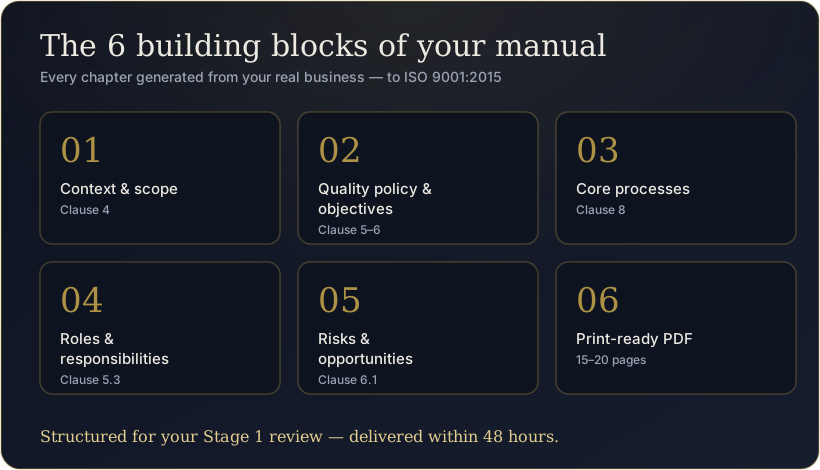
AlignedDocs gives you the documentation foundation — a tailored, standard-compliant ISO 9001:2015 quality manual — in 48 hours for €179. That gets your quality system started today, on the framework that carries forward into 2026 with only minor adjustments.
When the 2026 transition arrives, the changes are clarifications to a structure you already have, not a new document from scratch. Starting now with a clean, well-structured manual is the cheapest way to be ready for both today's certification and tomorrow's transition.
Source: ISO — ISO 9001 Quality management. Revision timing and transition figures reflect ISO/TC 176 guidance current as of mid-2026 and may shift.
Start on the framework that carries forward.
The core of ISO 9001 barely changes. Build a working quality manual now, transition with minimal effort later.